

Belize marked 50 years of its fixed exchange rate with the U.S. dollar at a September 23rd event. The Central Bank of Belize said it adopted the BZ$2 to US$1 rate on May 11, 1976. Officials at the event reflected on the peg’s history and what it will take to maintain it.
For Belizeans, the rate provides a familiar basis for calculating the cost of U.S. goods, overseas purchases and travel. The Central Bank describes the peg as an anchor for trade, investment, pricing and financial planning. It says the fixed rate also helps businesses make investment decisions with greater certainty.
The Central Bank’s account adds historical context to the anniversary. In 1894, when Belize was British Honduras, its currency was aligned one-to-one with the U.S. dollar. That arrangement changed in 1949 with a peg to the British pound sterling. The 1976 decision to set the rate at BZ$2 to US$1 marked a return to a U.S. dollar peg.
At the September event, Central Bank Chief Economist Emory Ford said the peg’s durability has depended on the institutions supporting it. “The peg’s durability depended largely on the evolution of institutions capable of preserving credibility,” he said, according to the remarks supplied for this article.
Ford explained that reserve requirements have changed alongside those institutions. Under the former currency board, reserve assets had to provide about 100% backing for currency in circulation. The statutory minimum fell to 50% under the 1976 Monetary Authority Ordinance and to 40% when the Central Bank began operating in 1982. He cautioned that the percentages are not directly comparable because the later requirements covered a broader range of liabilities.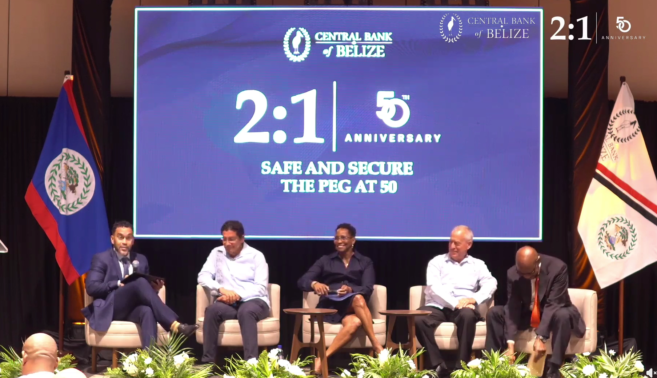
The Central Bank currently says it must hold external assets equal to at least 40% of its domestic liabilities. It also identifies managing credit growth as part of protecting foreign reserves and maintaining the peg.
Government Senator Christopher Coye reflected on the uncertainty earlier generations faced during changes to Belize’s currency arrangements. “They didn’t have income certainty. They didn’t have savings certainty. They didn’t have wage certainty,” he said, according to the supplied remarks.
Financial Secretary Joseph Waight said Belize had learned lessons from the economic difficulties other Caribbean countries experienced. Recalling the role of the 1949 exchange rate crisis in Belize’s nationalist movement, he described the two-to-one peg as “almost sacred and untouchable.”
Officials framed the anniversary as a reminder that the rate requires continued fiscal discipline, adequate foreign reserves, and confidence in the institutions responsible for monetary policy. The Central Bank has likewise said prudent reserve management and policies suited to a fixed exchange rate have helped sustain it through external shocks.
Share
Related Articles
Read more