
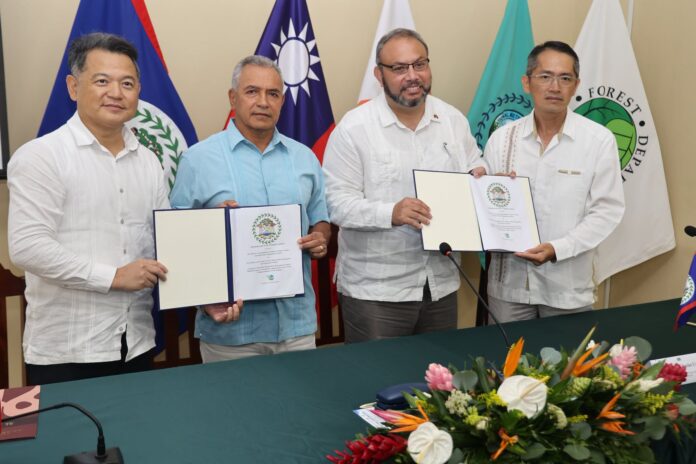
 officially launched a four-year disaster risk management initiative.)
On Friday, August 28th, the Governments of Belize and the Republic of China (Taiwan) officially launched a four-year disaster risk management initiative, marking a significant expansion of cooperation in climate resilience. The Belize Multi-Hazard Risk Management Capacity Building Project was launched through a Memorandum of Understanding (MOU) signed by the Minister of Sustainable Development, Climate Change and Solid Waste Management, Honorable Orlando Habet, and the Minister of the Public Service, Disaster Risk Management and Enterprise, Honorable Henry Charles Usher. Taiwan’s Ambassador to Belize, Amino Chi, witnessed the signing.
Funded by the Taiwan International Cooperation and Development Fund (TaiwanICDF), the project aims to strengthen Belize’s capacity to prepare for, monitor, and respond to natural hazards, with particular emphasis on flooding and wildfires.
Under the agreement, interventions will be carried out in 16 high-risk communities across the country to strengthen local preparedness and emergency response capabilities. The initiative will also finance the installation of three automated wildfire early-warning monitoring stations and provide specialized training to approximately 20 technical personnel in multi-agency coordination and hazard assessment.
The launch follows increased engagement between Belize and Taiwan. Minister Usher recently led a delegation to Taiwan, where he met with foreign affairs and education officials to discuss training opportunities for public officers and cooperation in disaster prevention.
Taiwan’s Ministry of Foreign Affairs noted that visits by Belizean officials reflect what Taipei describes as a “sincere and close” relationship spanning 37 years of diplomatic ties since 1989. The disaster management project builds on previous TaiwanICDF investments in Belize, including programs supporting women’s empowerment and youth entrepreneurship.
Minister Habet said the new initiative expands on an earlier project supported by the Taiwan Technical Mission and the Taiwanese Embassy to develop early-warning systems.
“We have seen that it has worked, but because of the work we do and the work that the ministry under Henry Charles does, we see there are a lot of similarities and cross-cutting issues,” Habet said. “We decided that, for us to work together, we had to develop a project with a multi-hazard risk management approach.”
Habet explained that the initiative will examine several potential hazards rather than addressing only one at a time. “We are looking at all the possible hazards that could affect Belize, and we have to be better prepared,” he said.
He added that the participating communities have already been identified and that a task force comprising representatives from both ministries has been established. The task force will work with project coordinators from the Taiwan Technical Mission to assess hazards within the communities and develop multi-hazard preparedness plans.
Ambassador Chi also highlighted Taiwan’s continued support for Belize during a related TaiwanICDF event on August 25th, when both countries signed a US$3 million agreement to support women and young entrepreneurs.
“It is my pleasure to announce that Taiwan and Belize will continue the initiative to empower women and youths in Belize,” Chi said. “The previous women’s empowerment project began in the aftermath of the COVID-19 pandemic and aimed to support the women most affected while creating opportunities for economic recovery in Belize.”
Although Chi’s remarks addressed economic programs, they reflected Taiwan’s broader commitment to strengthening resilience in Belize. The new disaster risk management project is expected to benefit vulnerable coastal and inland communities, including tourism-dependent areas such as San Pedro.
As an island community, San Pedro is particularly vulnerable to natural disasters such as hurricanes and tropical storms. Hurricane Lisa had minimal effects on the island in 2022 but left large amounts of debris along the shoreline and caused visible erosion in some areas. In October 2024, Tropical Storm Nadine brought flooding and erosion, although no major damage was reported. During these weather events, the local branch of the National Emergency Management Organization remained on standby to assist residents if necessary.
By installing three wildfire monitoring stations and enhancing technical training, Belize aims to reduce emergency response times and improve early-warning capabilities for hurricanes, flooding, and dry-season fires.
Over the next four years, the 16 participating communities are expected to improve local coordination, hazard-assessment capacity, and their ability to protect lives and livelihoods from increasingly frequent climate-related events.
Share
Related Articles
Read more