
The Government of Belize (GOB), through the Ministry of Human Development, Family Support and Gender Affairs and the National Women’s Commission (NWC), continues its nationwide series of public consultations on the proposed Domestic Violence Prohibition Bill. On Wednesday, December 17th, the campaign reached San Pedro Town, Ambergris Caye, where a consultation session was held at the former House of Culture. A small group of island residents attended, the majority of whom were police officers.
The consultations aim to provide the public with a clearer understanding of the proposed Bill, which seeks to strengthen legal protections for victims of domestic violence and to improve response systems nationwide.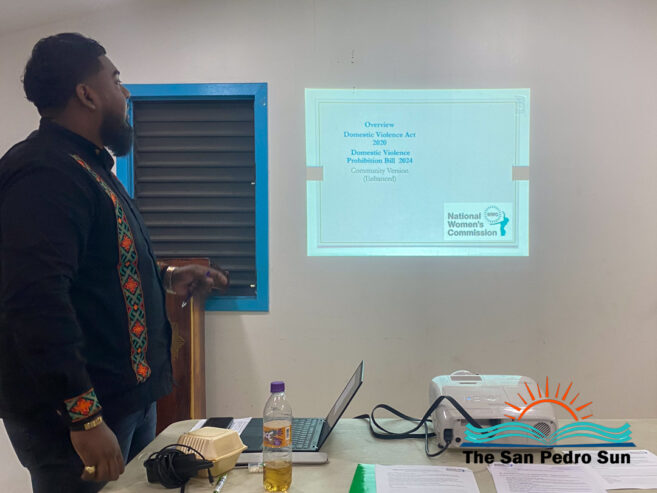
The informative session began shortly after 6:30PM with an overview of the existing Domestic Violence Act of 2020. Presenters explained that the Act provides legal mechanisms to protect individuals from abuse and ensure their safety. The proposed Domestic Violence Prohibition Bill builds on this framework by expanding protections and strengthening support services for victims.
According to the presentations, the proposed Bill will allow a broader range of individuals to apply for protection and will include provisions addressing cyberstalking and digital abuse. It will also strengthen protections for children and adolescents. Court proceedings are expected to become faster and more accessible, and victims will be able to apply for assistance online from anywhere in the country. Additionally, victims may request support from a social worker, and police must follow up on reports and, when necessary, provide protection within five days.
The consultation campaign led by the NWC revealed that Belize records more than 2,000 cases of domestic violence annually. However, presenters noted that this figure represents only about 40% of reported cases, with many incidents never reaching service providers. “We have had some heinous cases this year. It is sad to see the disrespect and lack of support for women and young girls. This Bill intends to protect them further,” one of the presenters said. The NWC views these consultations as an essential step in empowering the public to help shape legislation that directly impacts lives, particularly those suffering in silence.
The Bill was first introduced during a sitting of the House of Representatives on November 20th by the Honourable Thea Garcia-Ramirez, Minister of Human Development. She told the House that the legislation is being positioned as a critical step toward safeguarding families, reinforcing community support networks, and ensuring survivors of domestic violence can access timely justice and real protection.
Ramirez explained that the Ministry and the NWC issued an open call for participation from all sectors of society, including parents, teachers, youth leaders, community advocates, business owners, and concerned citizens, to attend consultations, share feedback, ask questions, and help shape the final legislation. She noted that a key component of the Bill is the expansion of the powers of Justices of the Peace (JPs).
“The idea for these amendments came from a senior justice of the peace, the Honourable Emilio Miguel Cal of Joseito Layout, Corozal Town, who saw an opportunity for JPs to be part of the solution in expanding access to justice for victims of gender-based violence,” Ramirez said. She explained that many victims urgently need protection orders at night, on weekends, on holidays, during emergencies, or when courts are closed or geographically inaccessible.
Ramirez stated that the proposed Justices of the Peace Amendment Bill 2025 would amend the Justices of the Peace Act, Chapter 1901, to empower designated senior justices of the peace to issue ex parte interim protection orders under urgent and exceptional circumstances. These orders would be valid for up to 72 hours, allowing protection until a magistrate can hear the matter.
“This is not a replacement for the courts,” Ramirez emphasized. “It is a life-saving bridge when the judicial system is temporarily inaccessible.” She added that interim protection orders may be issued when a magistrate is unavailable, outside regular court hours, when courts are closed, or in emergencies involving an imminent risk of harm.
To qualify, senior justices of the peace must have served for at least five years, have no criminal record, have no complaints against them, not be respondents in any domestic violence matter, and be willing and able to take on the responsibilities. Eligible candidates must formally apply to the Attorney General and will be designated only after consultation with the Family Court Director.
Public consultations continued on Thursday, December 18th, in Caye Caulker. The outcomes of consultations nationwide will be submitted to the Ministry of Human Development and later to the Cabinet. The Bill is then expected to be debated in the House of Representatives and the Senate before it can become law.
Share
Read more

 continues its nationwide series of public consultations on the proposed Domestic Violence Prohibition Bill.)