
As low temperatures continue across Belize, recent cold fronts have pushed February temperatures to record levels, particularly in the northern regions. On February 2, the National Meteorological Service reported new record lows in the north, with unusually cold conditions also observed in western districts and the Cayes. The coldest temperatures were recorded in Libertad Village, Corozal District, and Gallon Jug, Orange Walk District, where thermometers dropped to 41.7°F. Other parts of Orange Walk also experienced significant cooling, including Tower Hill at 46.1°F, while temperatures at the Philip S. W. Goldson International Airport, north of Belize City, fell to 50.9°F. In the west, Baldy Beacon recorded a low of 43.8°F, while Melinda registered 50.9°F. Low temperatures were also reported in the Cayes. In Caye Caulker, the lowest temperature was 60.9°F, while in San Pedro Town, Ambergris Caye, the lowest temperature was 59.7°F.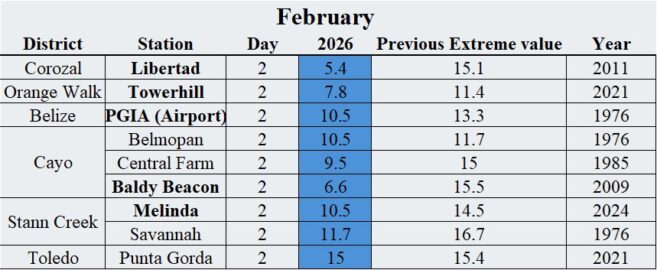
The National Meteorological Service also reported that another cold front is moving toward Belize and is expected to arrive by Friday, February 6. As a result, evening and early morning temperatures are expected to remain low through the week and into the weekend.
The weather outlook for the coming days includes generally cloudy skies with a few showers or periods of light rain over some inland, central, and southern coastal areas as the cold front crosses the country. Cooler and mostly dry conditions are expected to follow.
Internationally, the 2025–2026 winter season has been marked by notable cold outbreaks and variable weather patterns across much of the Northern Hemisphere. In the United States, a powerful winter storm and Arctic blasts brought widespread freezing temperatures, heavy snow, and record lows, even into typically milder southern states, prompting cold warnings and travel disruptions. Major cold snaps and extended freezing periods were also reported in parts of the U.S. Northeast, while southern regions, including Florida, experienced unusually cold air and frost events. Meteorologists note that broader climate patterns this season, influenced by La Niña and shifts in the polar vortex, have contributed to colder, more volatile conditions across North America and parts of Europe, with below-average temperatures and precipitation anomalies lingering in many areas.
National Meteorological Service Reports Record-Low February Temperatures

Share
Read more